You finish the fence first. It looks solid, private, and exactly how you pictured it. Then you hang the gate. A few weeks later it starts dragging. The latch needs a lift to close. A month after that, you’re pushing it shut with your foot.
This is how most privacy fences fail, not because of the fence panels, but because the gate was treated like an afterthought. Many “privacy fence gate ideas” focus on how the gate looks in a photo, not how it behaves once weight, movement, wind, and daily use are involved.
By the end of this guide, you’ll know which gate designs make sense for your opening, your yard conditions, and how the gate will be used.
Quick Take:
What Actually Matters When Choosing a Gate: Gate performance is driven by privacy level, usage frequency, wind exposure, slope, and structure—not looks alone.
Privacy Gate Design Ideas: Some designs adapt better to real openings and conditions, making them more reliable long-term choices.
How to Choose the Right Gate: Matching the design to yard layout and use reduces guesswork and prevents common failures.
Getting It Built the Right Way: Early design review, proper structure, and hardware selection matter more than last-minute fixes.
Final Takeaway: The right gate choice comes from aligning design, conditions, and construction—not picking a style in isolation.
What Actually Matters When Choosing a Privacy Fence Gate
A privacy gate isn’t just another fence panel with hinges. It’s a moving structure that has to stay square while carrying weight, resisting wind, and opening the same way every time. When those forces aren’t accounted for up front, the gate may look right but won’t function right for long.
Before choosing a style, these are the factors that determine whether a gate holds up or becomes a problem.
Privacy level (full vs partial)
Fully private gates add weight and create wind resistance. The more solid the gate, the more important proper framing and hinge support become. Partial designs reduce stress but change sightlines and airflow.
Daily use vs occasional use
A gate used multiple times a day needs stronger hinges, better alignment, and tighter tolerances. Designs that work for low-use areas often fail under daily traffic.
Wind exposure
Solid gates act like sails. In exposed yards, wind pressure accelerates sagging unless the gate is designed to resist racking and deflection.
Ground slope and clearance
Uneven grades affect swing direction, bottom clearance, and latch alignment. Ignoring slope early leads to dragging or forced adjustments later.
Pets and security needs
Gap spacing, latch placement, and closing force matter when containment or access control is involved. These requirements often limit which designs are practical.
Why gates fail first
Gates concentrate wood movement, leverage, and hardware stress into one moving component. Without the right structure, those forces show up quickly.
If you send a photo of the opening along with the width, height, and your privacy goal, Pacific Wood & Iron can recommend two to three gate styles that are most likely to operate cleanly and stay aligned long-term.
Once those basics are clear, the design choices get easier because you’re no longer guessing what might work,
Top 9 Privacy Fence Gate Ideas That Hold Up Over Time
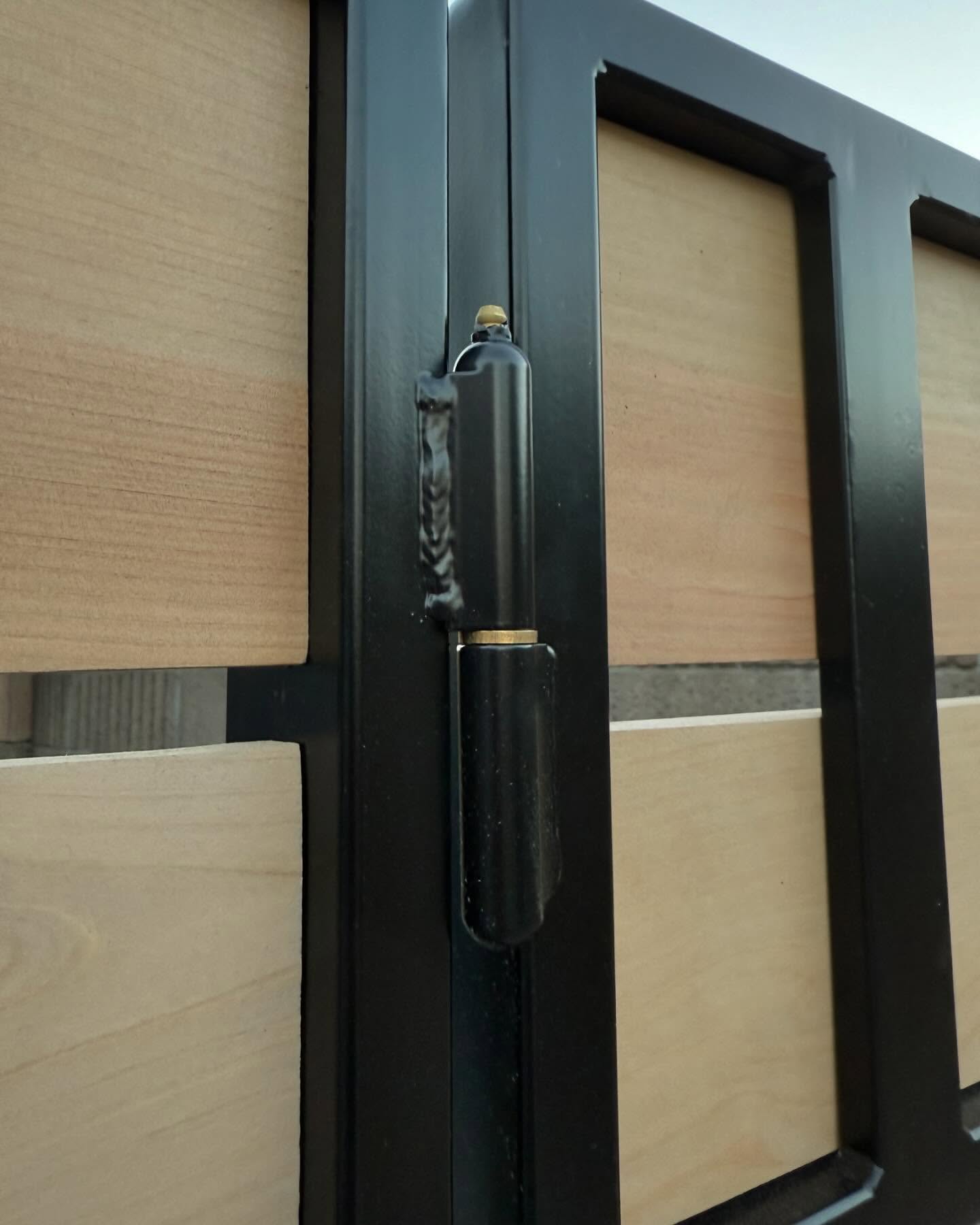
Once you start comparing gate options side by side, patterns emerge. Certain designs give you flexibility with materials, hardware, and layout, while others lock you into compromises from the start. That’s why the smartest choice often has less to do with style and more to do with how much control the design gives you.
The nine options below are gate designs that adapt well to different openings, privacy needs, and site conditions.
1. Horizontal Slat Privacy Gates
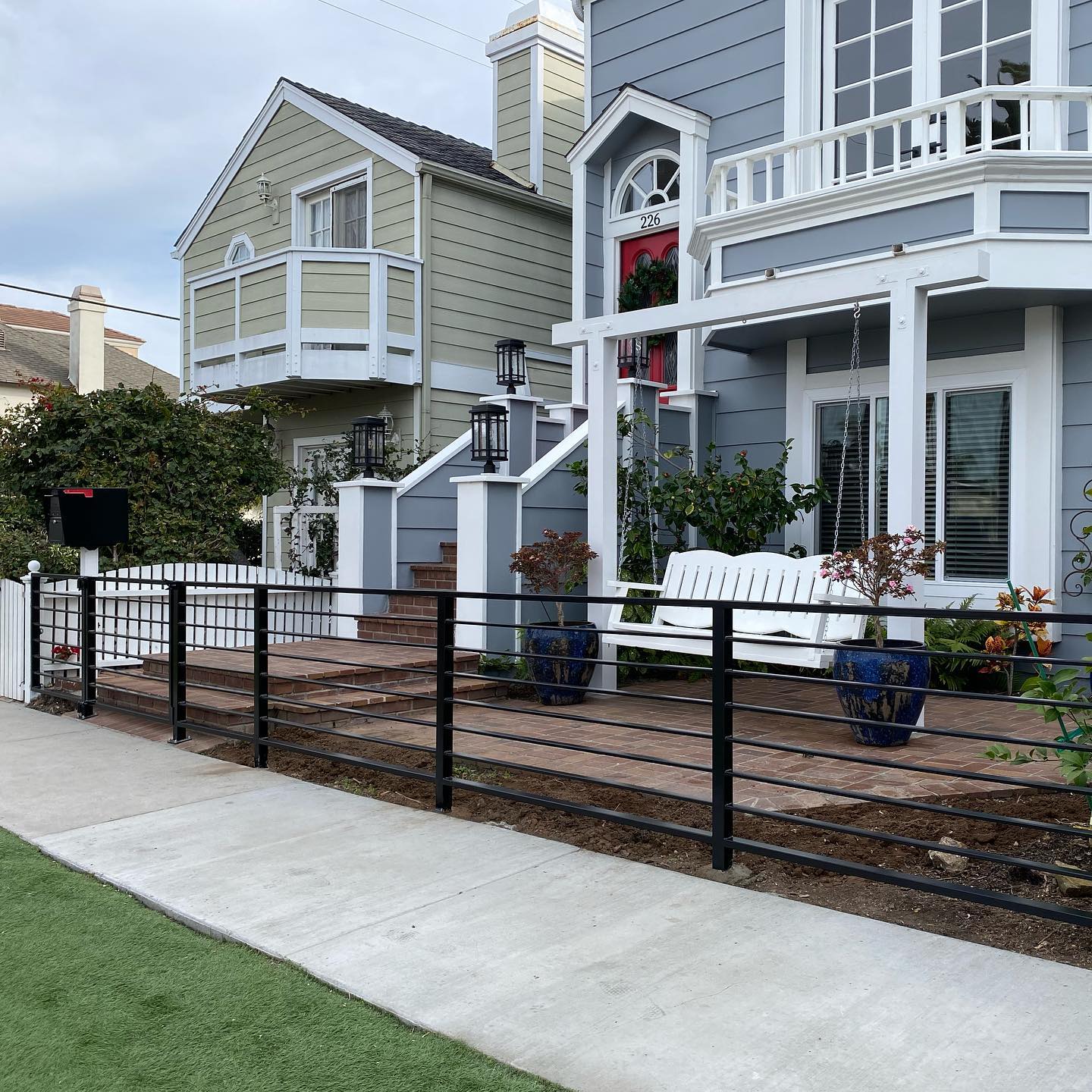
A horizontal slat privacy gate uses boards mounted parallel to the ground across a rigid frame, creating a continuous barrier that aligns visually with modern fence layouts.
Why Homeowners Choose It
This design makes sense when you want consistent privacy without breaking the flow of a horizontal fence line. It also allows controlled spacing between slats, which can help manage airflow and reduce wind pressure compared to fully solid panels.
Best Used When
The fence already uses a horizontal slat layout
Privacy is important, but some airflow is needed
The opening is moderate in width
The gate will be used regularly, not occasionally
Design & Build Considerations
Requires a rigid internal frame to prevent sagging
Slat spacing affects both privacy and wind resistance
Wider openings increase leverage on hinges
Hardware must be rated for the gate’s full weight
Maintenance Notes
Wood slats may need periodic adjustment or refinishing as they expand and contract over time.
2. Vertical Board-and-Batten Gates
A vertical board-and-batten gate uses full-height boards mounted vertically, with narrower battens covering the seams between boards to create a continuous privacy barrier.
Why Homeowners Choose It
This design works well when privacy and containment are the priority. The vertical layout naturally sheds water, and the battened seams help close gaps that can appear as boards shift over time.
Best Used When
Full privacy is required
The gate needs to visually match a traditional fence style
Containment for pets or children is important
The opening isn’t excessively wide
Design & Build Considerations
Vertical boards add significant weight, especially at taller heights
Battens must be fastened in a way that allows board movement
Proper bracing is critical to prevent racking
Hinge placement and post strength directly affect long-term alignment
Maintenance Notes
Periodic inspection is recommended to ensure battens aren’t restricting natural wood movement.
3. Picture-Frame Privacy Gates
A picture-frame privacy gate uses a perimeter frame around the gate with infill boards set inside it, creating a defined outer structure that carries the load.
Why Homeowners Choose It
This design offers more control over alignment because the frame resists twisting and sagging better than open-board layouts. It’s often chosen when a clean, finished look matters but long-term function is just as important.
Best Used When
The gate opening is wider than average
Consistent alignment is a priority
The fence design benefits from clean edges
The gate will see regular daily use
Design & Build Considerations
The frame must be sized to handle the full weight of the infill
Joinery at the corners is critical for rigidity
Infill boards should be fastened to allow for expansion
Hardware must be matched to the total framed weight
Maintenance Notes
Generally low, provided the frame remains rigid and fasteners are checked periodically.
4. Steel Frame with Wood Infill
A steel frame with wood infill uses a welded steel perimeter to carry the gate’s load, with wood boards installed inside the frame for privacy.
Why Homeowners Choose It
This design separates structure from appearance. The steel frame handles weight, leverage, and movement, while the wood provides the privacy and look homeowners want. It’s often chosen after dealing with gates that won’t stay aligned.
Best Used When
The gate opening is wide or tall
Long-term alignment is a top concern
The gate will be used frequently
Wind exposure is a factor
Design & Build Considerations
Steel thickness and weld quality determine rigidity
Wood infill must be installed to allow natural movement
Hinge selection must account for the combined weight
Proper coatings are needed to protect the steel frame
Maintenance Notes
Minimal structural maintenance; wood infill may require refinishing over time depending on exposure.
5. Shadowbox Privacy Gates
A shadowbox privacy gate uses alternating boards mounted on opposite sides of the frame, offset so the gaps are covered when viewed straight on.
Why Homeowners Choose It
This design provides privacy without fully blocking airflow, which helps reduce wind pressure on the gate. It’s a practical choice in areas where solid gates tend to catch wind and fall out of alignment.
Best Used When
Wind exposure is a concern
Full visual privacy is needed from straight-on views
Some light and airflow are preferred
The gate opening is moderate in width
Design & Build Considerations
Board alignment must stay consistent on both sides
The frame needs to resist twisting from uneven wind loads
Hardware should be rated for repeated movement
Clearance must be planned for boards on both faces
Maintenance Notes
Boards on both sides should be checked periodically to ensure fasteners remain secure as the wood moves.
6. Louvered Privacy Gates
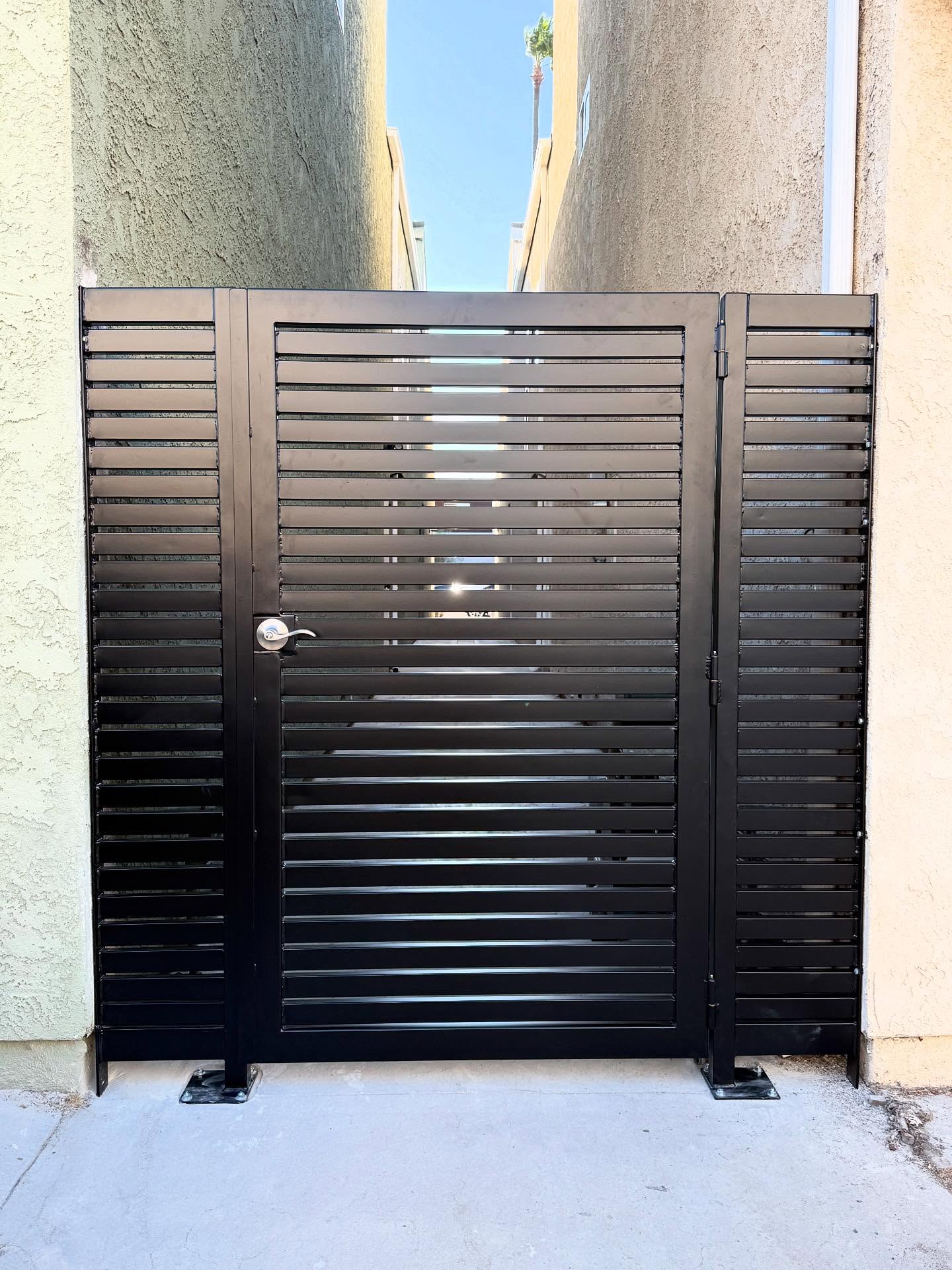
A louvered privacy gate uses angled slats set within a frame, allowing air to pass through while limiting direct sightlines.
Why Homeowners Choose It
This design balances privacy with airflow, which helps reduce wind pressure compared to solid gates. It’s often chosen where privacy is needed without creating a fully closed surface that catches wind.
Best Used When
Wind exposure is moderate to high
Partial visibility is acceptable at certain angles
The gate is in an exposed side yard
Airflow is preferred over a fully solid panel
Design & Build Considerations
Slat angle and spacing affect both privacy and airflow
Louvers require precise framing to stay aligned
Debris and moisture management should be considered
Hardware must support the added complexity of the frame
Maintenance Notes
Louvers may need occasional cleaning to prevent buildup that can affect appearance and drainage.
7. Double Swing Privacy Gates
A double swing privacy gate uses two hinged gate panels that meet in the middle, splitting a wide opening into two narrower leaves.
Why Homeowners Choose It
Dividing the opening reduces the weight and leverage on each gate, making alignment easier to maintain over time. It’s often the practical solution when a single wide gate would be difficult to keep square.
Best Used When
The opening is wide
Vehicle or equipment access is needed
A single large gate would be too heavy
The gate needs to stay usable with frequent operation
Design & Build Considerations
Center alignment and latching must be precise
Drop rods or ground stops are often required
Hinges must be matched to each leaf’s weight
Clearance and swing direction need careful planning
Maintenance Notes
Center latches and drop rods should be checked periodically to ensure both panels stay aligned.
8. Sliding Privacy Gates
A sliding privacy gate moves horizontally along a track or cantilever system instead of swinging inward or outward.
Why Homeowners Choose It
This design avoids swing clearance issues and eliminates sagging caused by gravity on hinged gates. It’s often chosen where space is limited or where a large opening needs to stay consistently aligned.
Best Used When
There’s limited space for a swing gate
The opening is wide
Ground conditions allow for a track or cantilever system
Consistent alignment is a priority
Design & Build Considerations
Track systems require stable, level foundations
Cantilever systems need proper counterbalance space
Gate weight must be carefully managed
Hardware quality directly affects smooth operation
Maintenance Notes
Tracks should be kept clear of debris to ensure smooth, reliable movement.
9. Laser-Cut Panel / Perforated Metal Privacy Gates
A laser-cut or perforated metal privacy gate uses a steel or aluminum panel with controlled cutouts mounted within a rigid frame to form the gate surface.
Why Homeowners Choose It
This design provides privacy without relying on solid mass. The pattern controls visibility and airflow while the metal panel stays dimensionally stable, making it a strong option where wood movement or wind has been an issue.
Best Used When
A modern or architectural look is desired
Partial privacy with airflow is acceptable
Long-term dimensional stability is important
The gate needs to remain flat and aligned over time
Design & Build Considerations
Pattern density affects both privacy and wind resistance
Panel thickness determines rigidity and vibration control
Proper finishing is essential to prevent corrosion
Framing must fully support the panel’s weight
Maintenance Notes
Typically low, with occasional cleaning and finish inspection depending on exposure.
Not sure which of these will work for your opening?
If you have a photo and rough width and height, Pacific Wood & Iron can help narrow it down to the gate styles most likely to stay straight and operate cleanly long-term.
How to Choose the Right Privacy Gate for Your Yard
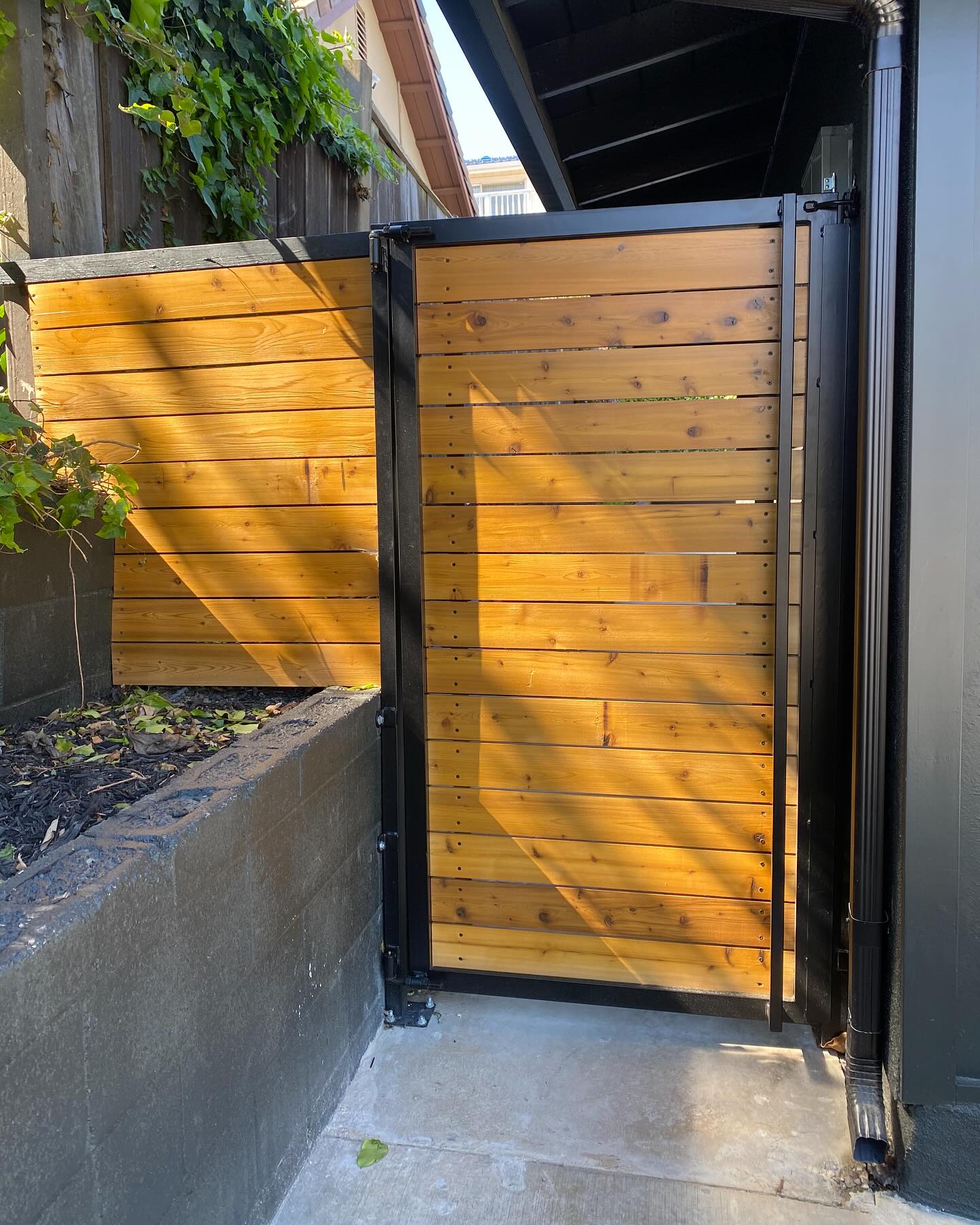
By this point, the differences between gate designs start to feel less abstract. What looked interchangeable at first now clearly isn’t. The right choice comes down to how your yard is laid out, how the gate will be used, and what conditions it needs to handle day after day.
If this sounds like your situation… | What usually works best | Why |
“I want full privacy, and I don’t want to see or be seen.” | Board-and-batten or picture-frame gates | These designs close visual gaps without relying on add-ons or screening |
“My last gate looked fine but slowly went out of alignment.” | Steel frame with wood infill | Separating structure from appearance limits movement and stress |
“It’s windy here, and solid gates feel like they’re fighting the air.” | Shadowbox, louvered, or perforated metal | Designs that let air pass through reduce long-term strain |
“The space is tight, and a swinging gate would be awkward.” | Sliding privacy gates | Eliminates clearance issues and uneven swing paths |
“The opening is wide, and one big gate feels like too much.” | Double swing gates | Splitting the load keeps each panel manageable |
“I want something that works without constant tweaking.” | Steel-framed or framed-panel designs | Structural rigidity reduces maintenance over time |
“I’m not sure what I want yet—I just know the old gate was a pain.” | Start with framed or steel-supported options | These designs leave the most room for adjustment later |
Once you’ve narrowed down which direction makes sense, the next step is making sure the design is built and installed in a way that actually supports it long-term.
How Pacific Wood & Iron Helps You Get the Gate Right
Once you know the direction you’re leaning, the real value comes from pressure-testing that decision before anything is built. A privacy gate isn’t something you want to “see how it goes” after installation. Small design choices: frame type, hardware, and clearances have outsized consequences later.
Pacific Wood & Iron works with homeowners and property managers who want clarity early, not fixes after the fact. The goal is to make sure the gate you choose fits the opening, the conditions, and how it will actually be used.
Here’s how they typically support that process:
Design feasibility review: Evaluating whether a chosen gate style makes sense for the opening size, slope, and exposure.
Structural guidance: Recommending when a framed or steel-supported approach is warranted to prevent long-term alignment issues.
Material selection: Helping balance privacy, airflow, durability, and maintenance expectations based on real conditions.
Hardware and access planning: Matching hinges, latches, and swing or slide systems to daily use and load requirements.
Custom fabrication: Building gates to the actual dimensions of the site rather than forcing standard solutions to fit.
If you’re ready to sanity-check a gate idea or want help narrowing down the right approach, reach out to us early and save yourself from costly adjustments later.
Conclusion
A privacy gate is one of those details that quietly defines how a property functions. When it’s right, you don’t think about it at all. When it’s wrong, it becomes a daily frustration. The difference with most privacy fence gate ideas isn’t the look, it’s whether the design is matched to the opening and environment.
That’s where working with a fabricator like Pacific Wood & Iron changes the outcome. Instead of choosing a design in isolation, you’re making decisions with structure, materials, and long-term performance in mind.
That clarity upfront is what turns a privacy gate from a recurring problem into a finished detail you can rely on for years.
FAQs
1. Are some privacy fence gate ideas easier to adjust later if my yard conditions change?
Yes. Designs that use framed construction or steel support give more flexibility if posts shift, the ground settles, or the gate needs realignment later. Simpler, unframed gates are harder to correct once they move.
2. How do I know if a privacy gate idea I like will feel too heavy to use every day?
A good rule of thumb is to think about how often the gate will be opened and by whom. Wide, fully private gates can feel manageable at first but become tiring or awkward over time if weight and balance aren’t addressed in the design.
3. Can privacy fence gate ideas affect how secure my fence line actually feels?
Absolutely. Latch placement, closing force, and how the gate meets the fence line all influence perceived security. Some designs look private but still leave leverage points or gaps that reduce real-world security.
4. Why do some privacy fence gate ideas look fine on paper but fail inspection or need changes on site?
Because drawings don’t always account for slope, post depth, or how hardware interacts with the surrounding fence. Designs that aren’t reviewed against actual site conditions often need last-minute adjustments.
5. Is it possible to combine two privacy fence gate ideas into one design?
In many cases, yes. Framed gates, steel-supported designs, or custom fabrication allow elements from different ideas to be combined, as long as the structure is designed to handle the added complexity.